Tapestry Solutions

Tapestry Solutions provides enterprise logistics software and services for global supply chains, mission planning, combat training and simulation systems.

Menu
  • About Us
      • Our Commitment & Culture
      • Major Programs
      • Industries We Serve
      • Community Outreach
      • Contact Us
        • U.S. Headquarters
          • 6910 Carroll Road
            San Diego, CA 92121-2211
            United States
            Tel: +1.858.503.1990
            Fax: +1.858.503.1999
            tapestrymarketing@boeing.com
          • Close
        • Europe Branch
          • Building 330
            The Crescent Bristol Business Park
            Bristol BS16 1EJ
            United Kingdom
            Tel: +44 117.931.9800
          • Close
    • Close
  • Solutions
    • Logistics Operations
    • Mission Planning
    • Mission Command Training
    • Technical & Field Support
    • Close
  • Products
    • GOLDesp MRO & Supply
    • Boeing Load Planner
    • Boeing Terminal Manager
    • Mission Management Suite
    • Enterprise Sensor Integration (ESI)
    • Close
  • Media Center
    • News & Insights
    • Video Gallery
    • Close
  • Careers
    • Job Search
    • Benefits
    • Close
  • Training & Support
    • Contact Customer Support
    • Technical & Field Support
    • Close

Delivering Weapon Planning Software – Faster, Better and Smarter

June 17, 2019

Tapestry Solutions will play a major role in modernizing Weapon Planning Software (WPS) over the next decade using an agile software development approach. The Boeing Global Services subsidiary is upgrading the WPS software under 10-year contract recently awarded by the U.S. Air Force. The WPS contract has a ceiling value of $259 million.

A pilot assigned to the F-22 Raptor Demonstration Team, Langley Air Force Base, Va., prepares for a demo. The F-22 is among multiple platforms that will receive WPS upgrades. (DoD photo: Staff Sgt. Ryan Campbell)

The WPS suite – a core component of the Joint Mission Planning System (JMPS) – will enable U.S. and partner nations to collaboratively plan for precision strike warfare on a more powerful software platform. It supports precision-guided munition (PGM) planning for A-10, B-1, B-2, B-52, F-15E, F-16, F-22, F/A-18 and F-35 aircraft.

“We are proud to deliver next-generation weapons software to our warfighters – and deliver it faster and more cost-effectively using an agile development approach,” said Debbie Churchill, vice president, Mission Products and Services, Tapestry Solutions.  “This will ensure our forces maintain the precision strike advantage, because in today’s battlespace, success depends on data, speed and interconnectivity.”

Why Agile Development?

Agile development places an emphasis on delivering many rapid iterations on a shorter timeline, allowing for a faster deployment of scalable, modular software. It enables developers to quickly respond to evolving requirements while ensuring quality.

“Agile software approach improves our ability to achieve first-time quality while meeting mission-critical deadlines,” said Jeff Mintzlaff, Tapestry’s director of Mission Planning. “This approach reduces costs, because customer involvement and buy-in are accomplished early and often in the development cycle.”

Many defense programs still use the traditional “waterfall” model, in which development is more structured and linear in nature. Waterfall development flows in a step-by-step sequential process, from conception and design through testing and deployment.

Tapestry’s WPS developers are also leveraging a software development model, called service-oriented architecture (SOA) to make it easy to integrate new capabilities over time. SOA is built with loosely coupled “services” that form a modular, layered architecture. SOA allows for greater customization and modularity that allow an enterprise system to evolve without costly redevelopment.

“Our development approach will ultimately aid in a faster release velocity for U.S. Air Force,” said Mintzlaff. “This will provide greater flexibility to integrate new weapons, platforms and emerging enabling technologies for the WPS program.”

A Closer Look at WPS & JMPS

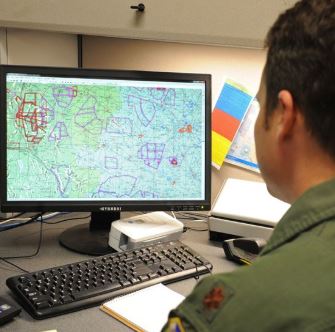
Airman pictured at screen with B-1 bomber mission planning software, which will be upgraded under the WPS program. (DoD photo/Airman 1st Class Peter Thompson)

The WPS software suite helps warfighters plan every detail of a mission, including route planning, flight simulation performance, threat avoidance, and points for weapons launches. The program centers around JMPS mission planning requirements for precision-guided munitions, such as laser-guided bombs and cruise missiles. PGMs are the weapon of choice for the U.S. Department of Defense, because they provide a high degree of accuracy in all weather conditions while avoiding widespread collateral damage.

The WPS program leverages Tapestry’s expertise in navigation, guidance and control telemetry technology, as well as its extensive experience with JMPS development. For the JMPS effort, software developers in St. Louis, Mo., are creating an innovative, cost-effective Unique Planning Component (UPC) for the F-15, F/A -18, F-22, and T-38.  The UPCs allow the warfighter to prepare the aircraft data necessary for mission execution.

The UPCs are a critical part of a system-of-systems called the Mission Planning Environment, or MPE, which provides the ability to interactively plan and validate missions. The MPE gives crews a full range of mission information, from preflight data reports to post-flight debriefing materials.

ABOUT TAPESTRY SOLUTIONS

Tapestry, which is part of Boeing’s services business, brings decades of experience developing mission planning software solutions for military aircraft including the F-15, F/A-18, F-22 and T-38, as well as weapons systems software for the Tomahawk missile and Boeing’s Joint Direct Attack Munition (JDAM) program.

Boeing is the world’s largest aerospace company and leading provider of commercial airplanes, defense, space and security systems, and global services. As the top U.S. exporter, the company supports commercial and government customers in more than 150 countries. Boeing employs more than 150,000 people worldwide and leverages the talents of a global supplier base. Building on a legacy of aerospace leadership, Boeing continues to lead in technology and innovation, deliver for its customers and invest in its people and future growth.

The appearance of U.S. Department of Defense (DoD) visual information
does not imply or constitute DoD endorsement.

Janet Dayton
Boeing Global Services
janet.l.dayton@boeing.com


Filed Under: Blog Posts Tagged With: Agile, JMPS, Mission Planning, SOA, Weapons Planning, WPS

How Load Planning Optimization Software Saves Time & Money – and Reduces Risks in Today’s Volatile Supply Chain

September 20, 2018

As today’s supply chains become increasing complex and volatile, having a sophisticated load planning solution is no longer an option – it’s a necessity. Embarkation specialists are constantly challenged with last-minute cargo changes, and they must respond quickly and efficiently to meet schedules and keep costs down.

However, without an automated system in place, logistics personnel must painstakingly re-calculate the balance, distribution and loading sequence for the cargo stowage. This laborious, manual process can result in costly delays and wreak havoc on the bottom line.

Tapestry Solutions, a Boeing Company, has addressed these challenges with the Integrated Computerized Deployment System (ICODES) and its commercial derivative, GOLDesp Load Planner.  In the process, Tapestry’s customers are saving millions annually.

WHAT IS ICODES?
ICODES –  designated as the Single Load Planning Capability (SLPC) for the U.S. Department of Defense (DoD) – is an intelligent software platform that provides near real-time planning and tracking of cargo stowage for ships, aircraft, railcars, trucks and yards.

ICODES automates processes for multimodal load planning, ensures better space utilization, and improves supply chain performance in support of the military’s deployment and distribution operations.

ICODES interfaces with multiple cargo documentation systems, allowing users to easily exchange and interpret global cargo movement plans throughout the enterprise. ICODES also sends alerts that notify users of violations in a load plan or estimation.  In addition, ICODES optimizes logistics operations for the day-to-day management of transportation terminals, and provides predictive analysis for future operations.

In the detailed description below, learn why ICODES has served as the U.S. military’s #1 load planning platform for decades –and how the same technology is assisting Tapestry’s commercial customers today.

THE SUPPLY CHAIN CHALLENGE
Transporting military assets involves moving a vast amount of cargo around the globe – everything from vehicles, weapon systems, ammunition to communication assets, fuel and food supplies – by land, air and sea. It also involves the staging of military personnel.

Managing all the variables is extremely complex in the theater of war. Logistics personnel face uncertainty, threats and information saturation on a daily basis. The load planning process typically involves several modes of transportation, last-minute cargo changes and hazardous conditions.

With continuous information changes and problems that arise, commanders need access to timely and accurate information – actionable data they can easily understand – as well as complete situational awareness.

Decision-makers require a transportation management solution that provides in-transit visibility, speed, extensive documentation accuracy, security, and above all else, automatic reasoning and analysis capabilities.

In the commercial domain, shippers also require supply chain visibility and automation to meet the demands of their customers. Elsewhere in the private sector, other entities have increasingly rigorous lifecycle requirements beyond, but closely related to, shipping – tracking parts and completing other tasks.

A FRAMEWORK FOR MILITARY LOADING AND MORE
ICODES provides the military with a flexible, modular, load planning solution that features automatic reasoning and analysis capabilities. Built with intelligent software agents, ICODES has provided the framework for U.S. military load planning operations for over 20 years.

ICODES first became the system of record for the U.S. Army’s ship load planning operations in 1997, and by 2001, the U.S. Marine Corps came onboard. The U.S. Air Force adopted ICODES in 2015, and in parallel, the functionality of ICODES progressively widened to include rail and then aircraft.

Today, ICODES serves as the DoD’s joint program of record for multimodal (air, ship, rail and truck) global deployments. Approximately 25,000 U.S. military user accounts around the globe have access to ICODES.

ICODES remains responsive to the dynamic logistics environment for its end users today, and continues to evolve to meet user requirements well beyond this decade. Recent enhancements include the delivery of an Initial Operational Capability for a Sea Service Deployment Module (SSDM) for ICODES software v7.1.  The SSDM enhancement provides the U.S. Navy and Marine Air-Ground Task Force (MAGTF) with a common operating picture for managing cargo and personnel movements via ICODES.

THE RETURN ON INVESTMENT
With ICODES technology, Tapestry calculates that the U.S. defense department is achieving annual sustainment cost savings of more than $10 million annually. These efficiencies are derived from its Service Oriented Architecture (SOA) environment, as well as its internal knowledge-base, intelligent software agents, and the automation of load planning task sequences.

As a result, ICODES has reduced the time to prepare load plans by 50% or more. In addition, users have access to myriad capabilities – all on a single platform – made possible with the SOA environment design principles (e.g., its standard API and “reusable” services).

The SOA infrastructure provides a highly modular, flexible platform that allows users to easily add new web applications and services, including legacy applications. This agile architecture provides a cost-effective way to add new capabilities to an enterprise-level system, for instance, without causing disruption to existing business processes within the system.

COMMERCIAL APPLICATIONS
Encouraged by U.S. military’s returns on investment,  ICODES technology has further been delivered to non-DoD customers as GOLDesp Load Planner and GOLDesp Terminal Manager commercial variants. Customers include the Royal Australian Navy, Royal Australian Air Force, Lithuania and NATO (Hungary) and Heavy Airlift Wing. These two commercial modules, which are fully compatible with ICODES, will be also be delivered to other nations’ defense forces over the next few months.

Tapestry’s customer base for non-defense operations is also diverse and expanding. In the public sector, the U.S. National Science Foundation has used the Load Planner tool in support of its Antarctica exploratory missions, enabling customized load planning for “routine” to the most challenging operational conditions requiring landing on sea-ice runways.

Other commercial entities that use the ICODES commercial modules include Wilhelmsen, Höegh Autoliners, Pasha Group, Liberty Global Logistics, SEACOR Holdings (previously as International Shipholding Corp.) and Logistics Management Institute.

The commercial customers use the technology to transport both commercial and military shipments, including cargo for U.S. DoD and international militaries.

THE TECHNOLOGY FOUNDATIONS
ICODES delivers six, high-level, functional capabilities to the customer. This suite of logistics services permit individuals in the logistics chain to intricately manage load planning, and successfully complete higher-order requirements up through managing ports, rail heads and other logistic nodes.

Artificial intelligence, in the form of embedded knowledge-based and rule-based agents, increase the speed, accuracy and quality of ICODES’ deployment operations.

Supply chains in the defense and commercial sectors also take advantage of SOA technology to complete lower-level, foundational capabilities, or micro services (services) for every requirement.

Combining these services within the SOA environment not only allows a system to execute highly complex computational tasks, but also extends the lifecycle of legacy systems. This, in turn, fills in functional gaps tailored to specific capabilities, allowing business processes to evolve.

A TEMPLATE FOR GROWTH
Current defense and commercial customers have further benefited from ICODES’ SOA infrastructure, which is made up of loosely coupled “services”  that are somewhat related but can also work independently to manage processes.  Its layered architecture is similar to the concept of LEGO blocks, allowing users to cost-effectively add functionality and easily evolve business processes.

This construct is permitting Tapestry’s development team to reuse existing functionalities, for example, and transition five legacy systems into a Cloud-compatible, Web application-based solution.

The implications of  service reusability is significant for prospective commercial and other customers, regardless of their annual sales volume, or other metric of size.  Rather than buy new off-the-shelf software, the end users can use service-oriented blocks in ICODES’ architecture to build “new” tailored software, scaled to their requirements.

With this feature, customers achieve greater flexibility, reduced development time and other costs, as well as increased system stability.

In one example of the state-of-possible, Tapestry’s engineering team built a software interface – from storyboarding through testing and fielding – and integrated a legacy system into ICODES in only 60 days.

Tapestry’s competencies in building software interfaces are well established, with approximately 25 interfaces supported by ICODES. The applications within ICODES include the Single Load Planner, Conveyance Estimator, Conveyance Builder, Data Manager, Data Cleanser, Conveyance Repository, Hand-Held Terminal Administrator, Information Repository, Breakbulk Tool, and more.

FUTURE ENHANCEMENTS & OPPORTUNITIES
Tapestry Solutions is focused on helping current and prospective customers keep supply chain costs down and gain other efficiencies through concurrent program and technology enhancements.

The DoD has contracted with Tapestry Solutions to redesign particular, remaining legacy logistics applications to become services-capable and link into ICODES’ SOA infrastructure – the Collaborative Information Workspace (CIW).

Beyond these programmatic advancements, future ICODES technology enhancements will leverage Tapestry’s competencies in RFID and its Enterprise Sensor Integration (ESI) solution, which in turn, will become part of the SOA infrastructure.

Tapestry Solutions is further staying ahead of customers’ imminent migration to Cloud providers for computational and data storage purposes via  research and development programs, including an effort involving a commercial sector, Cloud service provider.

In addition, Tapestry is refining other capabilities in the service-client architecture environment, including options as a software-as-a-service (SaaS) platform. An SaaS capability may conceptually provide military and commercial customers a “fee-for-service” or “pay-as-you-go” business model for ICODES/GOLDesp Load Planner access.

This technology thrust will further allow Tapestry Solution to move beyond the current ICODES program model of issuing quarterly, annual and other long-lead version upgrades, and be more continuously responsive (in weeks, or possibly days) to a customer’s change requests.

And finally, ICODES is transitioning from its Flash multimedia, software platform to the emerging Hyper Text Markup Language (HTML) 5 format. This technology enhancement will streamline the server-to-client data exchange, allowing ICODES customers to run the latest version of the system on even “older” hardware – with a Web-browser required.

With  these emerging and existing technologies, ICODES/GOLDesp Load Planner tools are designed to improve the efficiency and effectiveness of load planning operations for years to come. To learn more, contact Tapestry for consultation or email tapestrymarketing@boeing.com 

The appearance of U.S. Department of Defense (DoD) visual information
does not imply or constitute DoD endorsement.

Contact:

Janet Dayton
Tapestry Solutions Inc.
Boeing Global Services
tapestrymarketing@boeing.com

Filed Under: Blog Posts Tagged With: AI, Artificial Intelligence, ICODES, Load Planning, military deployment, Military Logistics, Shiploading, SOA, Terminal Management

Optimizing Supply Chains with Service-Oriented Architecture (SOA) – The Foundation for the U.S. Military’s ICODES Load-Planning System

September 16, 2017

All supply chains focus on keeping costs down by optimizing their existing processes and systems.  As the world becomes more complex, however, today’s systems have trouble keeping up with the demand to expand services and processes. As a result, organizations are leveraging the power of service-oriented architecture (SOA).

SOA gives organizations the agility and flexibility to connect legacy systems with new applications, saving time and money. In essence, SOA makes existing resources more productive and helps supply chains manage increasingly complex infrastructures.

Service-oriented architecture is by no means a new concept in the software industry – especially in the defense industry. The U.S. Department of Defense (DoD) has relied on SOA for over 20 years to optimize its load-planning processes.  While many claim that SOA is outdated, it is becoming more relevant than ever. In fact, SOA is alive and well and remains a solid foundation for enterprises.

As its name implies, service-oriented architecture is made up of loosely coupled “services” that are somewhat related but can also work independently to manage processes and create order. It is a cost-effective way to add new capabilities to an enterprise-level system, for instance, without causing disruption to business processes that are using the existing capabilities of the system.

The services within the SOA environment are designed to perform basic functions. Combining these functions into a service-oriented architecture not only allows a system to execute highly complex computational tasks, but also extends the lifecycle of legacy systems. This, in turn, fills in functional gaps tailored to specific capabilities, allowing business processes to evolve.

Similar to the concept of Lego Blocks, SOA facilitates easy connectivity to other applications – allowing users to add and enhance components over time.

 THE FRAMEWORK FOR MILITARY LOAD PLANNING

The modular, component-based SOA architecture is at the heart of the DoD’s load-planning system, known as the Integrated Computerized Deployment System (ICODES). The DoD adopted ICODES in the late 1990s when it recognized the need to consolidate the various maritime load-planning systems into one integrated computerized system. After reviewing several options, they found their solution with ICODES, developed by Tapestry Solutions, Inc.

Built from the ground up with SOA, ICODES was designed to address the complexities inherent in military load-planning – a process that involves the strategic placement of cargo and personnel as well as route optimization. As with commercial supply chains, the goal is to reduce transportation costs, save time and ensure the safety of cargo and personnel.

U.S. Navy photo by Mass Communication Specialist 3rd Class Nick Cerilli.

Load-planning is extremely complex for the military, which probably moves more freight than any other private enterprise or civilian operation, noted Stephen Goodman in his article, Strategic Load Planning.

“Basically, if America’s warfighters can wear it, eat it, drive it or shoot it, military logisticians are responsible for getting it to them,” Goodman explained.

More specifically, transporting military assets from the U.S. to overseas locations involves moving a vast amount of cargo – everything from vehicles, weapon systems, ammunition to communication assets, fuel and food supplies – by land, air and sea. It also involves the staging of military personnel.

Transporting the cargo safely and efficiently all begins with load-planning. “During load-planning, the loadmaster plans how to optimize the cargo space within an aircraft or container ship,” Goodman explained. “Overall, it is the responsibility of the loadmaster to ensure that the load can be safely carried by the transport, and on-loaded and off-loaded quickly and efficiently.”

MANAGING UNCERTAINTY, COMPLEXITIES IN THE THEATER OF WAR

In the theater of war, load-planning is compounded by uncertainty, complexity and information saturation. It typically involves several modes of transportation, last-minute cargo changes and hazardous conditions, according to the white paper, ICODES: A Load-Planning System That Demonstrates the Value of Ontologies in the Realm of Logistical Command and Control.

Oftentimes, there is a need for frequent re-planning due to changes in priority or as routes in the theater become temporarily unavailable due to inclement weather or enemy activities.

With continuous information changes and problems that arise during load-planning, commanders are saturated with a wealth of data in dynamically changing situations. They need access to timely and accurate information – actionable data they can easily understand and quickly exploit to make important decisions. Commanders also need complete situational awareness.

This requires a system that enables in-transit visibility, speed, extensive documentation accuracy, security, and above all else, automatic reasoning and analysis capabilities. Since shipments can be impacted by many factors during combat operations, the system must be adaptive and responsive.

To effectively address these complexities, it was necessary to find a flexible, modular solution that would consolidate all this data, and find solutions to problems as they arise. The solution should incorporate “intelligent software capable of analyzing the large amounts of data … and most importantly the extensive relationships that bind these components together,” according to the white paper.

AN INFORMATION-CENTRIC SYSTEM

With service-oriented architecture, the ICODES solution includes “expert software agents with automatic reasoning and analysis capabilities,” according to Dr. Jens Pohl, Chief Technology Officer, Tapestry Solutions. It was one of the nation’s first examples of “information-centric” military decision-support systems.

Its SOA interface allows “each service to be utilized in a manner that ensures that the end-product of one service becomes the starting point of another service,” asserts another white paper, Knowledge Management Enterprise Services (KMES) Concepts and Implementation Principles. This defining characteristic of service-oriented architecture enables a continuous flow of information, supporting multiple transportation and general logistics operations.

To be as flexible as possible, an SOA environment is “highly modular, platform independent, compliant with standards, and incorporates mechanisms for identifying, categorizing, provisioning, delivering, and monitoring service,” according to the white paper, authored by Dr. Pohl.

The modular software suite within ICODES, for instance, enables individual applications to work together and provide an array of capabilities. Each application performs specialized functions configured to interact with other applications either automatically or under the users’ direction.

The interoperability between applications is a key design feature of the ICODES suite, providing a flexible and comprehensive platform for the DoD and commercial users. The SOA architecture promotes better collaboration between users and its services. This ensures all stages of load-planning are managed effectively and efficiently.

ICODES: A DoD SYSTEM OF RECORD

ICODES has emerged as a system of record, serving as the single load-planning capability for the DoD. Among its functions, ICODES provides near real-time planning and tracking of cargo stowage for air, ocean, rail, and truck, allowing users to easily exchange and interpret global cargo movement plans. It also optimizes logistics operations for the day-to-day management of transportation terminals and provides predictive analysis for future operations.

Today, over 20,000 users rely on ICODES to create effective and efficient load-plans for vessels, aircraft, railcars and trucks/trailers. With is automatic reasoning and analysis capabilities, ICODES enables users to monitor various stages of the load-planning process and suggests solutions to existing and potential problems. For example, it provides notifications of issues such as weight imbalances and improperly stowed hazardous materials.

Its commercially available modules, called GOLDesp Load Planner and GOLDesp Terminal Manager, are also gaining popularity in non-DoD markets.

Because it is based on SOA concepts and design principles, ICODES’ functionality continues to expand – allowing users to quickly adapt to the fast-paced, mobile landscape within supply chains. Above all, ICODES helps commanders make sense of volumes of data, so they can make better decisions faster when every second counts.

The appearance of U.S. Department of Defense (DoD) visual information
does not imply or constitute DoD endorsement.

Contact:

Janet Dayton
Tapestry Solutions Inc.
tapestrymarketing@boeing.com


Filed Under: Blog Posts Tagged With: ICODES, Load Planning, Service Oriented Architecture, SOA, Web Services

ICODES Upgrades to Enhance Military Distribution and Deployment Processes for Joint Services

August 18, 2017

Tapestry Solutions, a Boeing Company, continues to enhance deployment planning and transportation functions for the U.S. Department of Defense (DoD) with its Integrated Computerized Deployment System (ICODES) – a DoD system of record for loading vessels, aircraft and railcars, as well as supporting yard management.

Most recently, Tapestry delivered an Initial Operational Capability for a Sea Service Deployment Module (SSDM) for ICODES software v7.1. SSDM provides the U.S. Navy and Marine Air-Ground Task Force (MAGTF) with a common operating picture for managing cargo and personnel movements via ICODES.

SSDM will replace the MAGTF (Marine Air-Ground Task Force) Deployment Support System, Version 2 (MDSS II) and merge its capabilities into ICODES. The MAGTF database enables commanders to manage, track and rapidly deploy a unit’s assets and personnel anywhere in the world.

ICODES has served as the DoD’s Joint Service logistics planning and execution system since 1997 and currently has over 30,000 global users.   The web-based enterprise technology provides end-to-end supply chain visibility of cargo load plans, including distribution forecasting and planning.

ABOUT ICODES

ICODES increases the efficiency of transportation planning performance by incorporating intelligent software agents that offer technical solutions to complex problems. The software agents monitor operations in near-real time, and issues alerts of inconsistencies for item placement and hazardous item segregation and storage. Users also have direct access to multi-user collaborative planning and comprehensive customizable reports.

A central component of ICODES is the Single Load Planner, or SLP, which interfaces with multiple cargo documentation systems to ensure the authenticity and accuracy of cargo data within a load plan.  The ICODES Terminal Management Module expands upon the basic yard capabilities in the SLP by adding the element of time, geospatial representation of the facility, and tracking the history of cargo items as they are manipulated.

Major features of ICODES include:

  • Load planning for ships, aircraft, railcars, and yards
  • Load estimation for pallets, containers, trucks, and trailers
  • Agent alerts that notify users of warnings or violations in a load plan or estimation
  • Near real-time tracking and monitoring
  • Representation of conveyance and cargo reference data
  • Service-Oriented Architecture (SOA) technology
  • Enterprise with stand-alone fallback capability

Commercial variants of ICODES include GOLDesp Terminal Manager and GOLDesp Load Planner.

The appearance of U.S. Department of Defense (DoD) visual information
does not imply or constitute DoD endorsement.

Contact:

Janet Dayton
Tapestry Solutions Inc.
tapestrymarketing@boeing.com


Filed Under: Blog Posts, Uncategorized Tagged With: cargo tracking, ICODES, Service Oriented Architecture, Single Load Planner, SOA, Web Services

Tapestry Solutions Announces Contract for ICODES Version 7

August 12, 2015

SAN DIEGO, August 12, 2015 – Tapestry Solutions, a non-fully integrated subsidiary of Boeing [NYSE: BA], was awarded a $16.3 million United States Transportation Command (USTRANSCOM) contract to enhance and sustain the Integrated Computerized Deployment System (ICODES). ICODES is a joint decision-support system that provides near real-time planning and tracking of cargo stowage for air, ocean, rail, and truck, allowing users to easily exchange and interpret global cargo movement plans.

“We are proud to have the privilege of supporting the ICODES program and continuing our deep commitment to the warfighter,” said Geoffrey Evans President & CEO of Tapestry Solutions and Miro Technologies. “This contract win is a testament to our innovative load planning and cargo management capabilities and the dedication of our people to the success of the program.”

ICODES increases the efficiency of transportation planning performance by incorporating expert computer agents that offer technical solutions to complex problems. The software agents monitor various stages of the load-planning process and suggest solutions, notifying users of issues with load plans.

“The win ensures that the warfighter will continue to receive the highest levels of load planning and terminal management support and service available in the DoD,” stated Tony Rigazzi, Vice President of Mission Products and Services of Tapestry Solutions.

ICODES is the United States Government’s single load planning solution. USTRANSCOM uses ICODES for global movements of cargo across all modes of transportation.

Tapestry will provide 18 months of software development and enhancements and three option years of sustainment support. The contract will be performed out of Tapestry’s San Luis Obispo, CA office and at Scott Air Force Base, IL.

Filed Under: Blog Posts, Press Releases Tagged With: ICODES, SOA

U.S. HEADQUARTERS

6910 Carroll Road
San Diego, CA 92121-2211
United States
Tel: +1.858.503.1990
tapestrymarketing@boeing.com

Links

Menu
    • About Us
    • Solutions
    • Products
    • Media Center
    • Careers
    • Training & Support

PRIVACY NOTICE

The Privacy and Cookie Statement for The Boeing Company and its family of brands has changed, effective May 22, 2019, to allow for a more unified customer experience. You can review the updated Statement here.

Copyright ©2025 Tapestry Solutions Privacy PolicyTerms & Conditions Cookie Settings

Thank you for your interest.
Please fill out the information below to access this white paper.

Thank you for your interest.
Please fill out the information below to access this case study.